

Table of Contents
- How to Measure Lingerie Size: What You'll Need
- Tools for Accurate Measuring at Home
- How to Measure Bra Size: Band and Cup
- How to Measure Panty Size: Waist and Hips
- How to Measure for a Bodysuit
- Using a Lingerie Size Chart and Size Conversion
- What to Do When You're Between Sizes
- Fit Checks After You Measure
- Conclusion: Confidence Starts with the Right Measurements
- Frequently Asked Questions
Last Updated: October 6, 2026
How to Measure Lingerie Size: What You'll Need
Learning how to measure lingerie size takes about five minutes and one soft measuring tape.
Here's the part most guides miss: your size is not one fixed number. It changes by brand, by garment, and even by the time of month.
Below, we'll show you exactly how to measure at home, interpret the numbers, and confirm fit before you buy.
Tools for Accurate Measuring at Home
A soft measuring tape is the only tool you truly need. Fabric tapes flex with your body, which is why tailors use them instead of the stiff metal kind from a toolbox.
If you don't own one, here's what works in a pinch:
- A piece of string or ribbon, then lay it flat against a ruler
- A phone charging cable, measured the same way
- A tailor's tape from any drugstore or craft shop
A few other things help:
- A mirror, so you can check the tape sits level
- A well-fitting unpadded bra, or no bra at all
- A friend, if you can find one, for back measurements
How to Measure Bra Size: Band and Cup
Bra size comes from two numbers: your band size and your cup size. The band is the snug measurement around your ribcage. The cup is the difference between that band and your fullest bust measurement.
Get those two numbers and you can read any brand's chart with confidence.
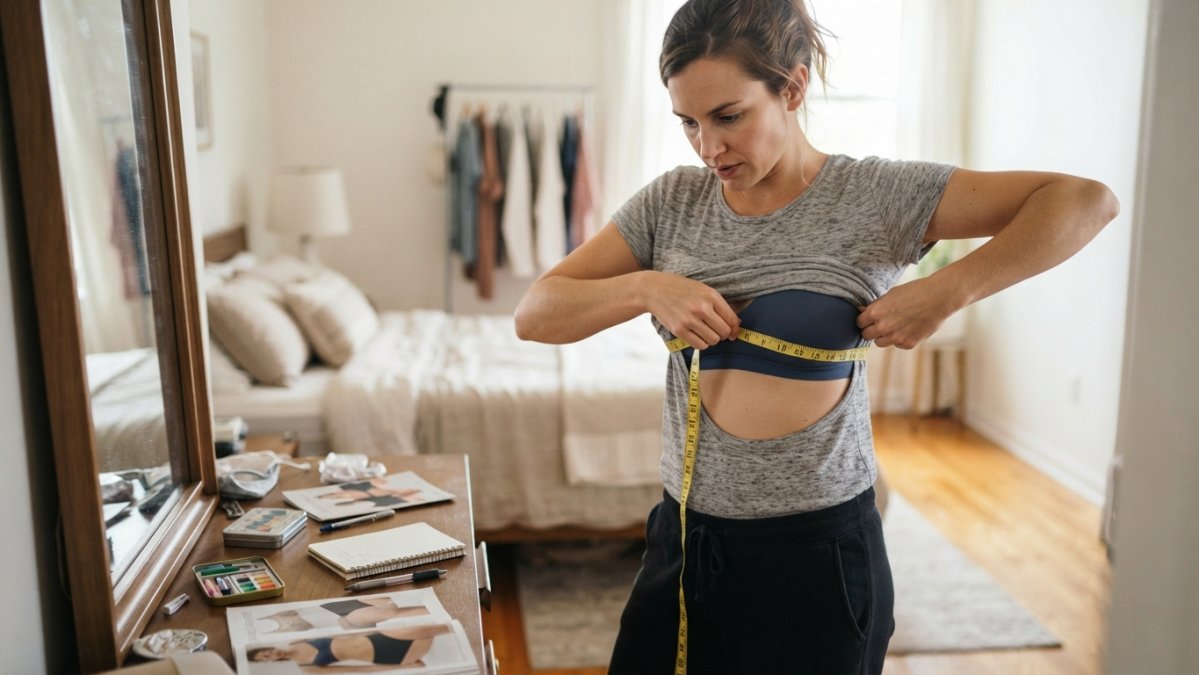
Measuring Your Underbust and Bust
Start with the underbust, also called the band measurement. Wrap the tape around your ribcage, right under your bust, where the bra band would sit.
Keep it snug. Not tight enough to dig in, but close against the skin. Round to the nearest whole inch.
- Underbust: tape snug under the bust, level all the way around
- Standing bust: tape around the fullest part of the bust, arms relaxed at your sides
- Leaning bust: bend forward at the waist, then measure around the fullest point
The leaning measurement matters for fuller busts. Breasts sit differently when you bend, and that difference tells you whether you need a larger cup.
Calculating Your Cup Size
Cup size is simple math: bust measurement minus band measurement.
Take your underbust number and add 4 if it's even, or 5 if it's odd. That gives your band size. Then subtract the band size from your bust measurement.
| Difference | Cup Size |
|---|---|
| 1 inch | A |
| 2 inches | B |
| 3 inches | C |
| 4 inches | D |
| 5 inches | DD/E |
| 6 inches | DDD/F |
So a 34-inch underbust with a 38-inch bust lands at a 34D. That's the starting point, not the final word. Sister sizing means a 34D fits close to a 36C, which helps when a brand runs small.
How to Measure Panty Size: Waist and Hips
Panty size comes down to two numbers: your natural waist and your hip measurement. Most brands build their size chart around those two points, so getting them right matters more than any single letter. The trick is measuring the same way the brand's fit team did, because a hip measurement taken at the wrong height can swing two full sizes.
Finding your natural waist
Find your natural waist by bending sideways. The crease that forms is your waist, usually just above the belly button and below the bottom of your ribcage. Stand tall, exhale normally, and measure there with the tape relaxed against your skin. Do not suck in or pull the tape tight. A common pattern is for people to measure the narrowest point they can create by holding their breath, which produces a number that no garment will match.
- Natural waist: the crease when you bend sideways, tape relaxed and level
- Upper hip: about 3 to 4 inches below the waist, across the top of the hip bones
- Full hip: the widest point around your seat, usually 7 to 9 inches below the natural waist
Measuring the hip correctly
Stand with your feet together and run the tape around the widest part of your seat. Keep the tape parallel to the floor all the way around. If you measure alone, use a mirror to check that the back of the tape is not riding up.
Write all three numbers down. A brand's size chart may ask for any of them, and a size recommendation based on the wrong point will steer you wrong.
Turning waist and hip numbers into a size
Once you have both numbers, compare each one to the brand's chart separately, then pick the size that fits the larger measurement.
A few practical notes:
- Cotton and microfiber briefs usually have enough give to size down if you are between sizes.
- Lace and mesh have less recovery, so size up rather than risk a waistband that digs.
- Shapewear and compression styles are cut to fit snug, so follow the chart exactly rather than sizing down.
- If you are buying a matching set, check whether the top and bottom are sold in separate sizes, since many brands now offer that.
If you are measuring for someone else, ask them to stand naturally and breathe normally. A measurement taken while someone holds their breath will read smaller than the body actually is, and the garment will feel tight from the first wear.
How to Measure for a Bodysuit
Bodysuits need a third number: your torso length. A bodysuit that fits the bust and hips can still pull, ride up, or gap if the torso is off.
Measure from the top of your shoulder, down over the fullest part of your bust, through the crotch, and back up to the starting point. That loop is your torso length.
Then compare it to the garment measurements in the product details.
Using a Lingerie Size Chart and Size Conversion
A lingerie size chart is the bridge between your measurements and a brand's actual sizing. Every brand cuts differently, so the same measurements can land you in a medium at one label and a large at another. The chart on the product page is the only one that matters, because it reflects how that specific style was graded.
How to read a chart without guessing
Here is how to use a chart well:
- Find the chart on the product page, not a generic one from a search
- Match your measurements to the closest range, not the letter you usually wear
- Check the size conversion table if the brand uses UK, EU, or international sizing
- Read the fit notes, which often say whether a style runs small or large
- Look at the model stats if the brand lists them, since that tells you how the garment fits a real body
Most charts list a range rather than a single number, such as a waist of 27 to 28 inches for a medium. If your measurement sits at the top of one range and the bottom of the next, you are between sizes, and the next section covers how to choose.
Size conversion across systems
Sizing systems vary, and the differences are larger than most people expect. A US size 8 is not a UK size 8, and cup letters shift once you cross a DD.
When a chart offers size conversion, use it. When it does not, look for a bra size calculator on the brand's site or reach out to their team. A calculator is only as good as the numbers you feed it, so measure first and enter the results rather than guessing.
bra size calculator and conversion guidance
When the chart and your measurements disagree
Sometimes your measurements point to one size and the chart's fit notes point to another. In that case, trust the fit notes for that specific style. A structured balconette and a stretch lace bralette can share a size label and fit completely differently.
A few common patterns:
- Sports bras and compression styles are often graded tighter, so size up if you are between sizes.
- Bralettes and wireless styles have more stretch, so size down if you want a closer fit.
- Bodysuits and shapewear are graded to the torso, so check the torso range before the bust or hip range.
At Doctor John's, our staff can talk you through a brand's sizing over the phone before you order, which saves a lot of back-and-forth on returns.
What to Do When You're Between Sizes
Falling between sizes is normal, not a sign you measured wrong. Bodies rarely land on exact chart lines.
When you're between sizes, decide by garment:
- Bras: size up in the band if the underbust is snug, then adjust the cup
- Panties: size up for comfort in cotton and lace, size down for compression styles
- Bodysuits: follow the torso length first, since that's the hardest to adjust
Also think about fabric. Stretch lace forgives half an inch. Structured satin does not. And if you're buying for a specific occasion, order both sizes when the return policy allows it.
Fit Checks After You Measure
Numbers get you close. A fit check confirms you got it right. Do this the moment your order arrives, before you cut any tags.
For a bra:
- The band sits level and snug, and you can fit two fingers under it
- The center gore lies flat against your chest
- Straps stay put without digging into your shoulders
- The cups hold everything with no gaping or spillover
For panties and bodysuits:
- The waistband doesn't roll or dig
- The leg openings lie flat with no cutting
- A bodysuit's snap closure sits comfortably, not tight
If something's off, note which measurement was wrong. That tells you whether to adjust your size or your measuring method next time.
Conclusion: Confidence Starts with the Right Measurements
Fit problems are frustrating, and they're the main reason lingerie sits unworn in a drawer. The fix isn't luck. It's a soft tape, five minutes, and a brand whose chart you trust. Doctor John's has helped customers find their fit since 1987, with thousands of pieces across a real size range and staff who answer the phone when you're unsure.
Frequently Asked Questions
How do you measure yourself for lingerie at home?
Start with a soft measuring tape and wear a non-padded bra. Measure your underbust snugly, then your bust at the fullest part. For panties, measure your natural waist and upper hip. Write down each number in inches. Use those measurements against a lingerie size chart, and if you fall between sizes, size up for comfort.
What should you do if your measurements fall between sizes?
When your measurements fall between sizes on a lingerie size chart, choose the larger size for panties and bodysuits to avoid digging or pinching. For bras, if your underbust is between band sizes, go with the larger band and adjust the cup accordingly. Many brands offer inclusive size ranges, so check product details for specific fit notes before ordering.
How do you measure your band and cup size?
Wrap a soft measuring tape snugly around your ribcage directly under your bust for the band size. Round to the nearest even number. For cup size, measure around the fullest part of your bust while standing. Subtract your band measurement from your bust measurement. A 1-inch difference is typically an A cup, 2 inches a B, 3 inches a C, and so on.
How do you measure for a lingerie bodysuit?
Bodysuits require your bust, natural waist, and upper hip measurements, plus your torso length. Measure from the top of your shoulder, down past your bust and waist, to your crotch. Compare this length against the bodysuit's size chart. If your torso is longer than average, size up to avoid pulling. Always check the product details for stretch and adjustable straps.